

With the increasing interest in UFOs, both public and private, Tyler Cowen asked: “How should you change your life decisions if we are being watched by alien drone probes?”
The crux of his claim:
The most plausible decision however is to slightly lower your level of ambition. Consider a few of the core scenarios.
If the aliens go rogue on us and end it all, the efforts you might be making now will have been for naught.
If the aliens are here to cap the level of human achievement, for instance to keep us on Earth and prevent us from exploring the galaxy, yet without harm, you also can scale back your ambition a bit. You do not need to invest so much capital in supporting the space program. Most of your more local ambitions however should remain untouched. You might even become more ambitious in keeping the Earth a safe place, since escape hatches are now less likely. Alternatively, you might think the aliens are our “saviors of last resort,” but that too probably makes you less ambitious.
A more general Bayesian update is simply that human efforts, in the broader scheme of things, have lower relative marginal products than you might have thought. The aliens apparently have lots of powers, at least if they managed to get here. That too militates in favor of lowering your ambitions. Conversely, if you start believing we are the only intelligent, agentic beings in the galaxy, arguably, you should increase your ambitions. There will be fewer outside forces to stop, limit, or reverse your efforts.
If UFO reports are true, and they represent a technologically advanced alien intelligence, in my experience, they should actually make you more ambitious.
1. Incredible Physics is Possible
Accepting his premises, Alien UFOs imply travel across light-years and are reported to display incredible performance, like:
Instant acceleration and turns, yet g-forces don’t crush the craft
Flight propulsion without reaction mass or aerodynamic control surfaces (i.e., no rockets, turbines, rotors, or wings)
Medium-independent travel: Moving in and out of water at speed, flying supersonic without skin-heating or a sonic boom
If this level of technological mastery is physically possible, we’ve been underestimating possible performance envelopes by orders of magnitude. For example, if you’ve been working on solar sails or fusion rockets for interstellar travel, this should update you towards more ambitious Alcubierre drives and wormholes.
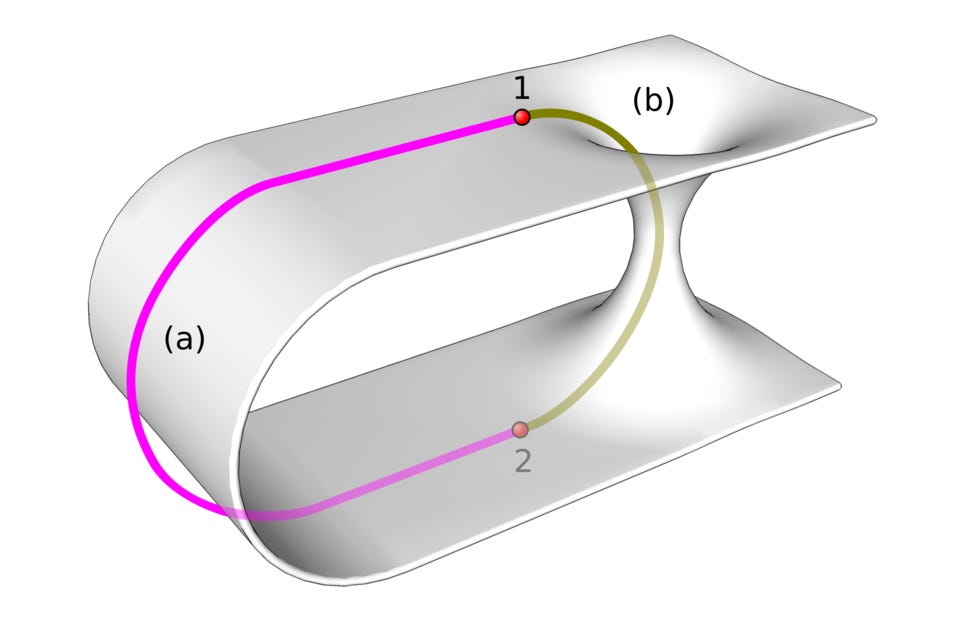

The same could be said for anyone working on energy, materials, and, of course, fundamental physics. The physical ceiling of what’s possible is taller than expected, so you should be reaching higher.
It also applies to anyone downstream of potential technological developments. Just as AI should make a lawyer more ambitious because it’s a force multiplier for their work, introducing advanced power and materials technology should similarly make an AI scientist more ambitious. However, materials and energy go into everything (indeed, they are the only physical inputs), so it’s hard to think of any builder who wouldn’t need to update.
(It is possible aliens could want to cap our technology, but as of yet, there are no reports of this, outside of particular weapon systems. If anything, it’s more frequently claimed that they have actually advanced our own technology, including intentional gifts.)
2. Your Priors About the Impossible Should Drop Globally
I, like most people, used to think that UFOs were ridiculous and in the same category as Bigfoot and the Loch Ness monster. Nutcases believed in them because they wanted it to be true, to feel special, and to enjoy confirmation bias.
Now I feel that I owe the UFO nuts an apology. I’m not claiming they’ve been definitively proven right, but evidence has come out that they don’t belong in the same category as other conspiracy theorists.
This means I was globally miscalibrated. My model of the world was too narrow, so I should broadly update to be more open-minded about crazier things.
And if crazy things are more possible than we realize, then we should inch closer to being crazily ambitious. So maybe reconsider that biological immortality, space datacenter, or brain-uploading project.
3. AI Less Likely to Kill Us
If you’ve been less ambitious because you think there’s no point in building if AI might kill all of us soon, Aliens should revise that possibility downwards for two reasons:
Safe superintelligence is possible, demonstrated by aliens who have not killed us. They might not be AI themselves, but given how advanced the rest of their technology is, they probably have AI too.
They may be, as Tyler said, “saviors of last resort” and reportedly do disable our nukes, though not our data centers, implying they regard nukes as the danger.1
4. We’re In a Competitive Environment
When people are in competition, they work harder if the game seems winnable, and decrease effort if they think they’ll lose. It’s implied that because humans are so far behind aliens, we are uncompetitive and so should put in less effort.
However, we don’t know how many players there are in this game or how they’re organized into factions. There may be exactly one intelligence in the galaxy, but there probably are not exactly two.2
As an example, during the Taiwan Strait crisis, they were weaker than either the PRC or the US, but by playing off the geopolitics, Taiwan still exists as an entity. If we were to enter a galacto-political game, we should do so from as strong a position as possible, as the matter could even be existential.
So if you ever begin to consider that UFOs could be real, I hope it makes you more ambitious. I speak firsthand, because it’s been the single biggest ambition amplifier I’ve ever had: pushing me from wanting to be a “success” to wanting to be a Copernicus.
One could speculate that they disable nukes because that’s how we would resist them, but this again implies that AI would be less dangerous to them.
In a Poisson distribution, the rate λ is either small, so the number of events is typically zero but occasionally one, or not small, in which case the cumulative probability of more events dominates.
are there specific evidences that made you update your belief that UFO claims were kooks?