

In the paper Life Before Earth, Sharov and Gordon quantified the complexity of life by measuring the amount of functional and coding DNA in organisms’ genomes. They didn’t simply use the size of the whole genome because of the C-value Paradox, which is the puzzling fact that a genome’s size, measured in picograms, doesn’t correspond to complexity. For example, there are single-celled protozoa with genomes much larger than Homo sapiens’.
(The mechanics of the complexity quantification are described in another paper, and it amounts to counting only the parts of the genome that can't be changed without breaking the organism.)
A plot of the complexity of various genomes vs. the time they first emerged shows an exponential curve. This makes sense, as it represents a continuous growth rate, and the paper calculates that life on Earth has averaged a ~1.8% increase in complexity every 10 million years.1
Below is a log plot of this:
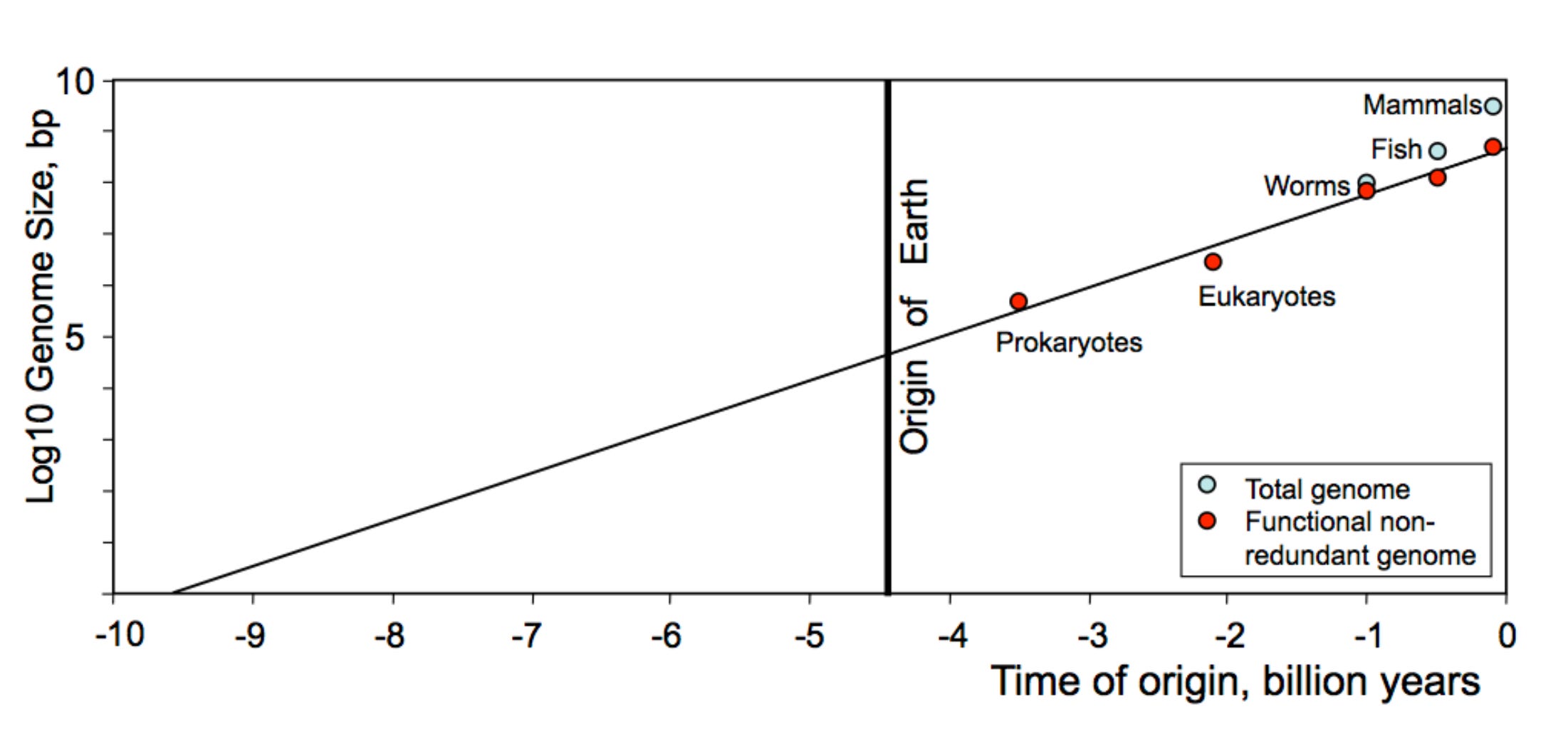
On a log plot, the exponential function appears as a straight line. We can see that life on Earth aligns with the trend line, confirming that the expansion of complexity is exponential.
Interestingly, though, you can also project backward to see when the genome should have started. This requires the assumption that early organisms didn’t advance faster than later ones, but the authors argue that if anything, without template-based replication, early organisms should have advanced more slowly than they do today.
From the plot, you can see that life appears to have begun close to 10 billion years ago, with the paper reporting 9.7 ± 2.5 billion years. This is, at a minimum, about 3 billion years longer than Earth has existed.
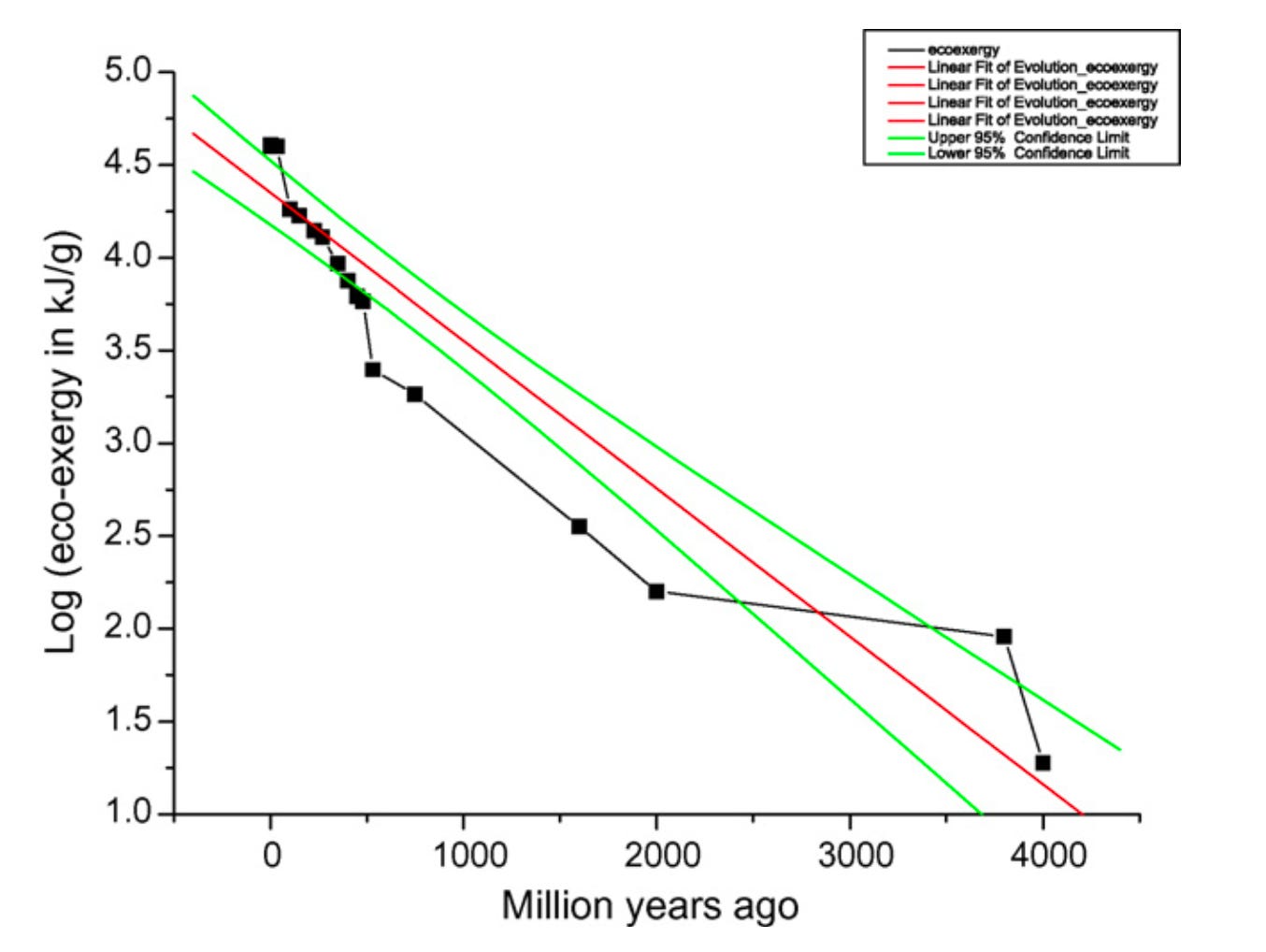
Surprising. Even more surprising is that when Sven Jørgensen did a similar analysis, but using a form of energy density instead of genome complexity, he found that life’s expected origin was 5-6 billion years ago. This is still 1-2 billion years older than what’s possible on Earth.
Panspermia
These results support an earlier idea, panspermia, which is the theory that life originated elsewhere and was spread to Earth. Our planet is relatively young; three-quarters of planets in the universe are estimated to be older, by nearly 2 billion years on average.
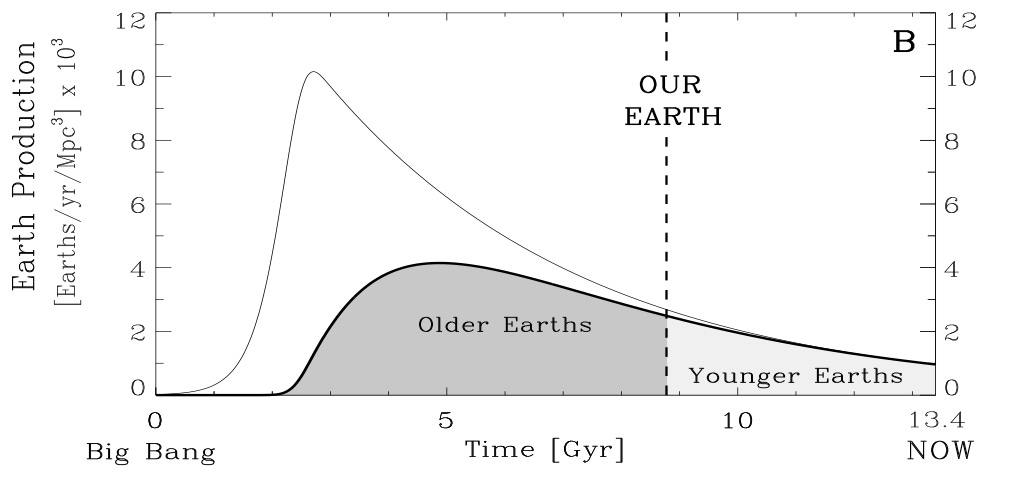
The oldest planets in the galaxy are over 12 billion years old, long enough to have originated life, according to the extrapolations from the two papers.
So yes, there are planets old enough, but could life from those places ever reach Earth?
NASA tested just that, by exposing bacteria endospores to space for 1.5 years. Endospores are special, desiccated hibernation states that certain bacteria can enter when under stress and deprivation. If curious, below is a pleasingly retro 90-second clip about how bacteria become endospores:
NASA found that bacterial endospores were hardy to temperature fluctuations, vacuum, and cosmic radiation. They were only harmed by UV light. This implies that if protected from UV, for example, by being shadowed or buried, bacteria could survive the conditions of space.
But for how long? The NASA test was for 1.5 years, and most endospores survived. However, the oldest endospores ever revived were recovered from the abdomen of a bee, preserved in 25-40 million-year-old2 amber. In our region of the Milky Way, solar systems average only about 5 light-years apart, and Proxima Centauri, the nearest star to Earth, is about 4 light-years away. If endospores can also survive millions of years in space (and not just in amber), then they could manage the travel time between star systems.
Finally, panspermia requires a mechanism. This is proposed to be debris ejected from asteroid impacts, and simulations have shown particles from Earth could end up as far away as Jupiter. With enough time and enough impacts, this could end up in a different solar system.
Taken together, two independent extrapolations find that life appears to predate the Earth. This doesn’t prove panspermia, but otherwise, life would have had to arise and quickly develop immediately following Earth’s formation and cooling.
And at this point, I’m not sure which is the stranger story.
Calculated from a 376-million-year doubling time.
The age of the bee is known because it was preserved in Dominican amber, which only comes from the extinct Hymenaea protera, which grew during that time period.