

A common question about UFOs is “why now?” As in, UFOs could have arrived at any point in Earth’s history; why would they happen to arrive in the 20th or 21st centuries?
One reason could be that they were attracted by our 1900s radio broadcasts or nuclear tests, but I think it’s more likely they’ve always been around and we only recently had the technology to detect them.
If you consider that for most of human history, “sensing” was limited to humans’ sensory organs, then it wouldn’t matter how long they’d been here if we couldn’t easily see or hear them. Telescopes emerging in the 1600s raised our detection capability, but in a pre-industrial, and more importantly, pre-digital world, the rate of improvement was slow.
However, in recent decades we’ve been developing exponentially, with sensing-relevant technologies like transistor density, memory capacity, and photon capture doubling every 1-2 years. As progress speeds upwards, the rate of improvement is proportional to the likelihood of detection, because each marginal advancement provides a new chance to detect ETs.
Compared to our stagnant past, we’re more likely than ever before to reach the technological level required for ET detection.
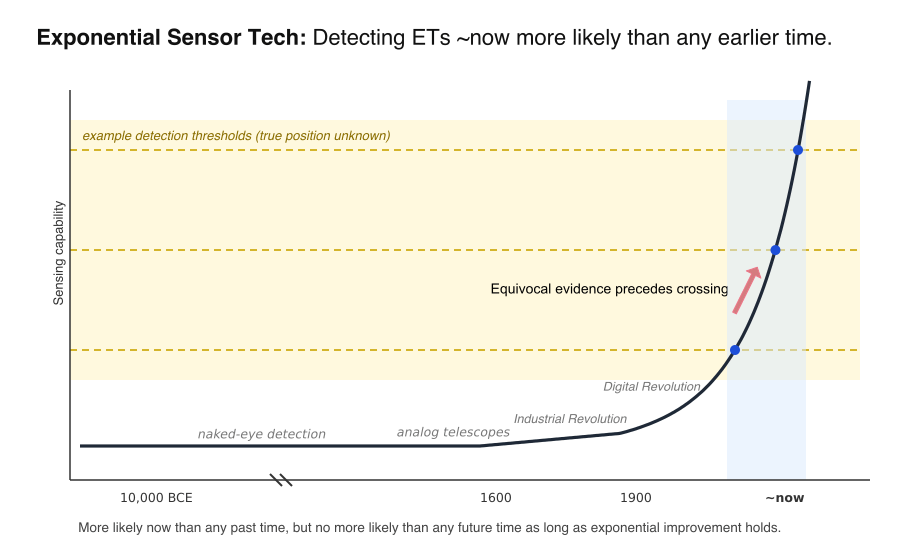
That said, indefinite exponential growth only means detecting the previously undetectable is more likely than in the past, but not necessarily more likely than in the future.
If it’s an S-Curve, not an Exponential
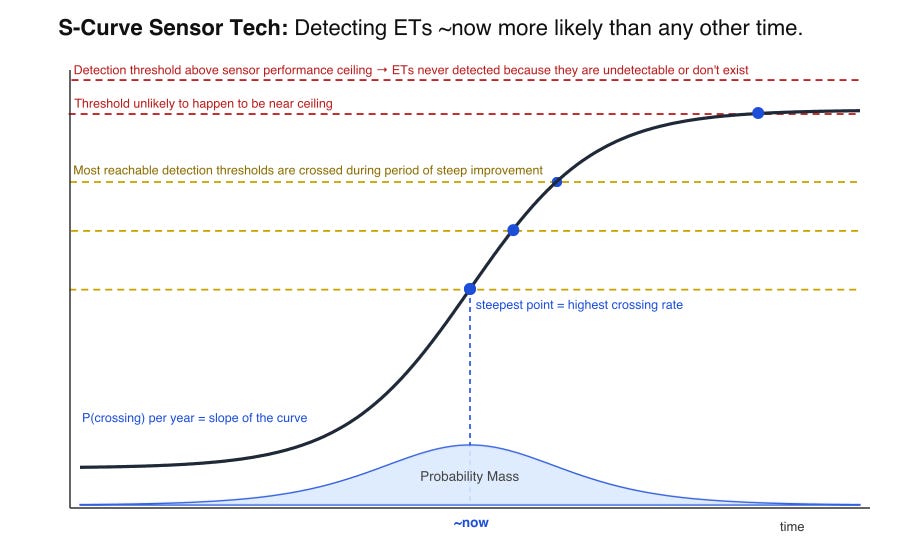
S-curves that eventually flatten can look like exponentials at first. Individual technologies will eventually plateau as they hit physical limits; for example, a camera can do no better than capturing every single photon that enters its aperture.
Overlapping S-curves of related technologies can keep progress going, but even when aggregated, a technological domain is likely to eventually slow. If sensor technology is really an S-curve, then where we are now, in the steep part, is the most likely time for us to find extraterrestrials ever.
The upshot of all this is that one planet’s inhabitants are most likely to detect another when:
Its prior history was characterized by universally low technological development.
Its technology is currently improving exponentially.
It has recently begun to pick up equivocal evidence of other civilizations.
It seems we are in this position now, so we should expect to find aliens around now, if ever.
TLDR: Seem to be a bunch of extra effects which could keep the probability increasing into the future.
Interesting article. That said, I feel like this argument assumes that we don't keep scaling our technology in the future right? If we're early in the S-curve then the most likely time to find them is later on once we reach the steeper part.
I also think there's probably a bunch of maths that could be done with this idea in a more thorough investigation taking into account e.g the extra volume of stars we'd be able to detect different levels of alien intelligence at - you could have the sensor quality flatten off, but because the # of stars is proportional to r^3, the searchable space increases, not to mention e.g the computing power and/or number of telescopes at a certain power level required to search that space.