

A rogue wave is one you didn’t expect. They’re defined as being at least twice as big as the biggest waves nearby, and being rare, they catch navigators off guard.
Below is a video of an Alaskan crabboat being hit by one:
Rogue waves were not only unexpected by sailors, but also by scientists until 1995, as they didn’t fit their statistical models.
It can be tempting, therefore, to call rogue waves a black swan event: an unknown unknown that arrives without warning and catches us completely off guard.
But when black swans were thought not to exist, no European had ever seen one. Since black swans are endemic to Australia, it was a reasonable, if premature, assumption, and there was no biological model purporting that black swans couldn’t be.
Rogue waves are different, though. The concept was known because sailors had been reporting them for centuries, but they were simply not believed.
"Myth” of the Rogue Wave
On Christopher Columbus’s 3rd voyage, he encountered “a rogue wave as high as the ship’s masts…it lifted the vessels; hoisting them higher than anything the Admiral had ever experienced.” Similarly, in 1826, naval officer and scientist Jules Dumont d’Urville, along with three colleagues, reported waves above 30m (100ft) in height in the Indian Ocean.
Despite similar reports from these credible witnesses, they were ridiculed as sailors’ tall tales. Waves were thought to follow a Gaussian normal distribution (also known as a “bell curve”), and waves like that were thought to only happen once in 10,000 years.
It was an example of locked-in priors, where an existing model of the world disallows certain claims. Anyone who says otherwise is stigmatized, and their evidence is dismissed, so the model is never updated and further hardens to countervailing evidence.
Why No Better Evidence?
There could be a literal survivor bias here, in that most sailors who saw a rogue wave may never have lived to see anything else. Even those who survived were easy to dismiss because eyewitness testimony can be unreliable.
After widespread adoption of cameras, though, there was still a lack of physical evidence. Below are two of the only known pre-1995 photos of rogue waves:
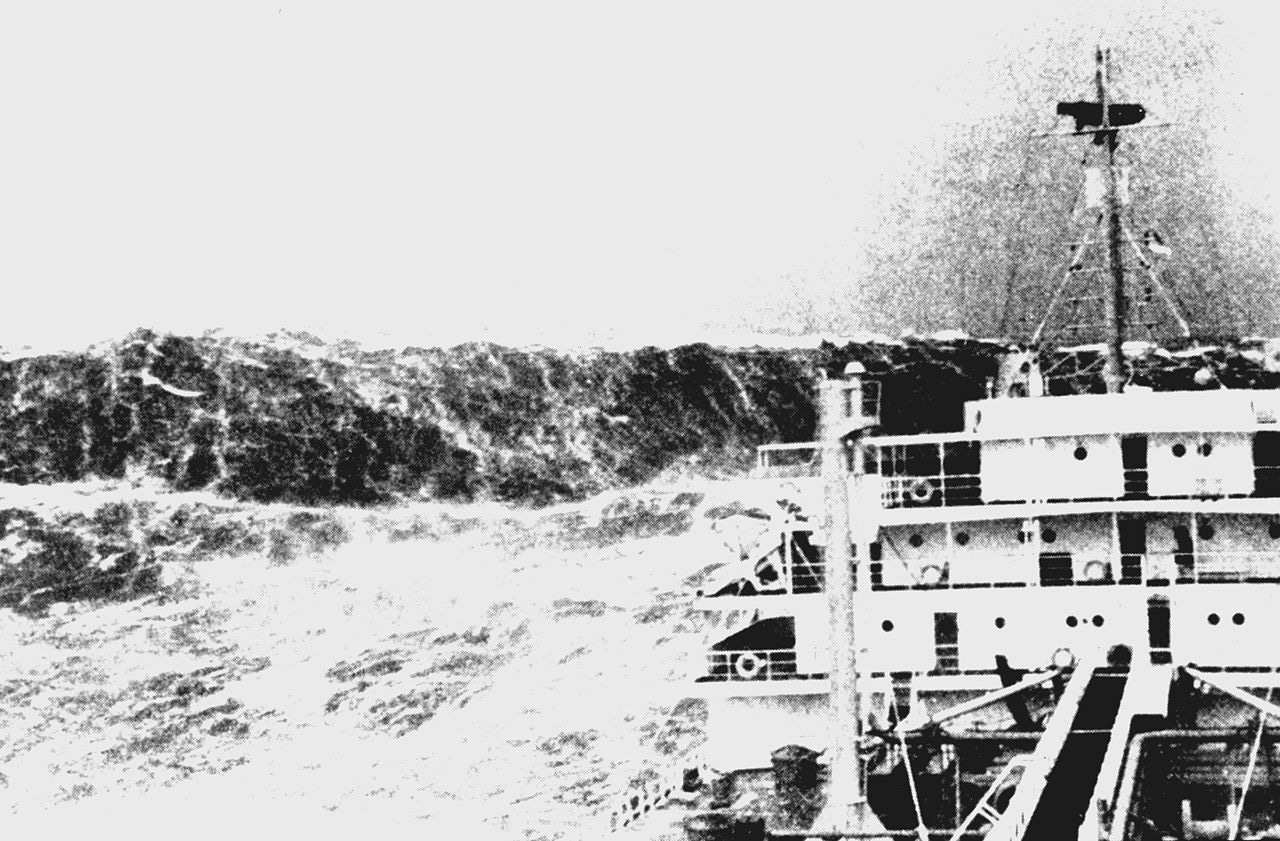

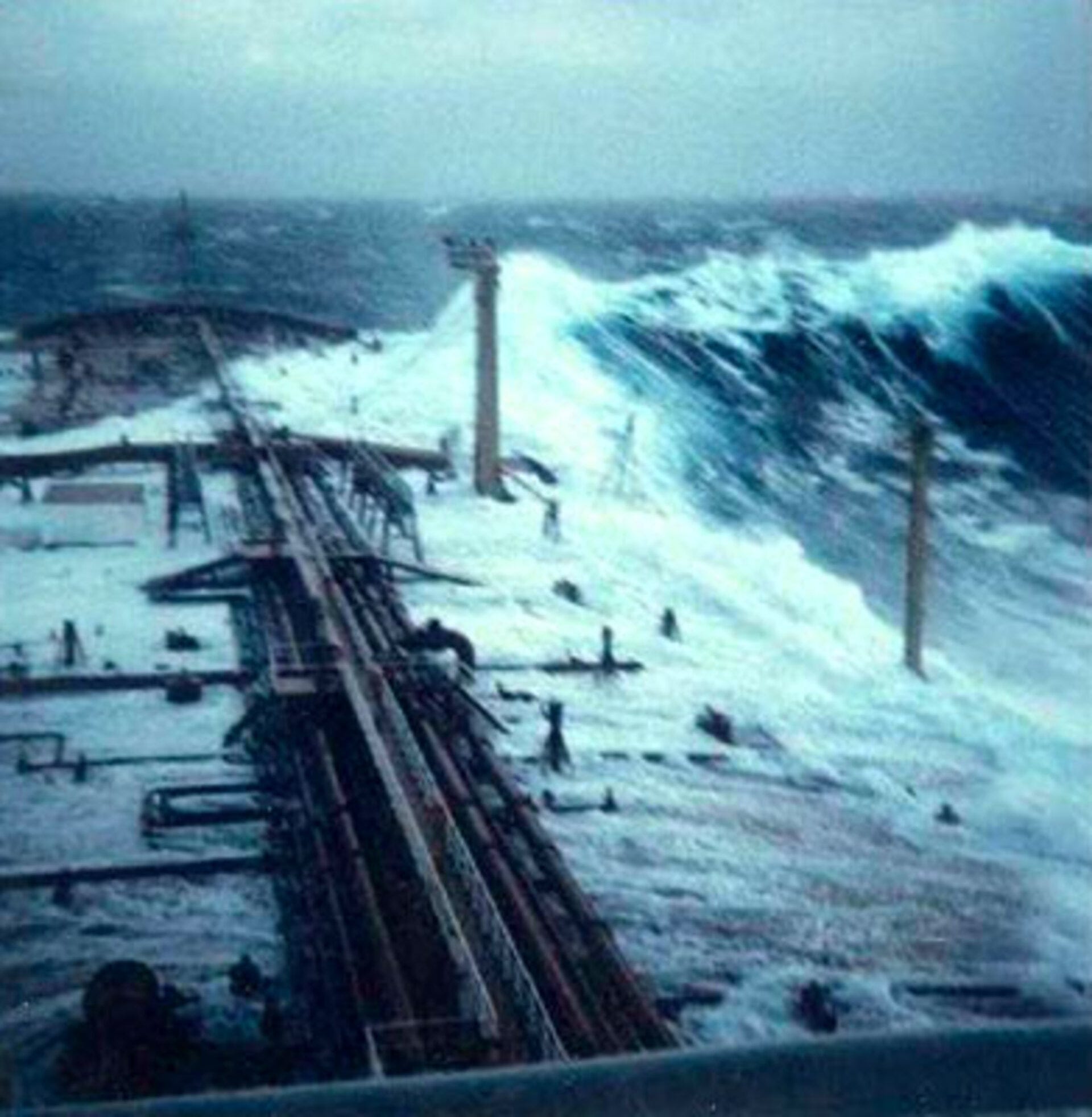
The first is grainy and looks like it could be a distant mountain range. The second is blurry, and it’s not clear that the flooding is from a huge single wave, as opposed to rough seas or an already-swamped ship. The photos just aren’t that convincing.
Even today, with camera phones everywhere, there are hardly any videos of rogue waves. The crabboat clip is the best that exists1, and it shows the aftermath, rather than the wave itself. A YouTube search will provide impressive-looking clips, but they are either AI-generated or aren’t really rogue waves.
Rogue waves are infrequent, sudden, disjarring, and difficult to film, which has prevented any airtight photographic or video evidence, despite being real.
How Scientists Were Finally Convinced
Finally, on January 1st, 1995, a wave measuring 25.6 m (84 ft) tall was recorded by laser rangefinding sensors on a gas platform in the North Sea.
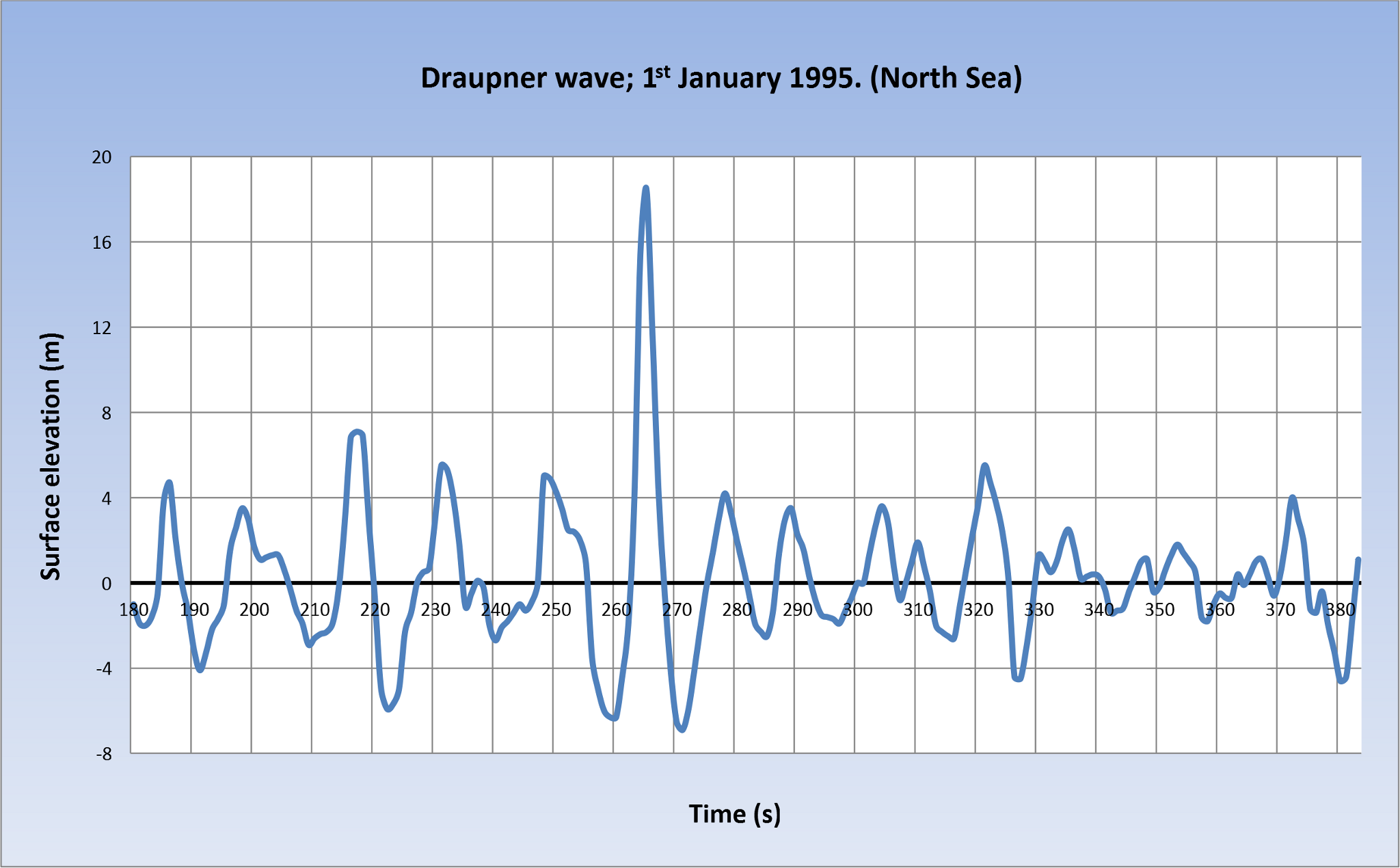
Initially, the results were disbelieved, but corroborating data and physical damage high up on the platform confirmed that the readings were accurate. Scientific interest and credulity followed.
That said, did we really have to wait until the mid-90s for laser rangefinding? Likely hundreds of ships and their crews were lost every decade to rogue waves, and engineers didn’t start designing with them in mind until after the scientific consensus had come around.
Rogue waves are literally unexpected events that were once dismissed as impossible, and can also figuratively describe similar scenarios. The most fitting is the 2008 financial crisis because not only were there dismissed prior warnings, but the failure mode was the exact same incorrect application of a Gaussian distribution!2
Regular readers may know where I’m going with this, but I’ll spell it out now. The story of rogue waves shows it’s possible for a scientific phenomenon to be: 1) widely reported, 2) poorly photographed, 3) considered a myth, and 4) 100% real.
Or possibly one other video.
More examples of things considered myths until surprisingly recently: gorillas (1847), pandas (1869), komodo dragons (1910), meteorites (1803), and red sprites (1989).
Rogue waves were well recorded off the East coast of South Africa. They were, as noted, because of the superposistion of waves from different directions in the strong, fast Aghulus current and opposing winds. It is believed this may have been the cause of the sinking of the SS Waratah in July 1909 which disappeared without a trace. She was a 9000 ton ship with a capacity for 700 passengers!
Other examples of reports being denied and then vindicated: meteors, germ theory, plate tectonics, sprites, and ball lightning (which I have seen personally).
Next up: alien visitation.