

Everything that happens once can never happen again. But everything that happens twice will surely happen a third time. — Paulo Coelho, The Alchemist
In software engineering, the zero, one, infinity (ZOI) rule means that you should allow zero instances, one instance, or any number of instances of something. For example, this post is allowed to have zero embedded tables (Substack lacks this feature), one subtitle, and an infinite number of likes (hint, hint).
This is a reflection of a pattern in real life, the ZOM principle, which is that there are zero, one, or many of a thing, not exactly two.
Examples of Zero, One, Many (ZOM):
Reproductive partners: (none) asexual reproduction, (one) sexual reproduction, (many) some slime molds and fungi (10² - 10⁴)
Dialects in a language: (none) language is dead e.g. Sanskrit, (one) single dominant dialect e.g. Icelandic, (many) large number of dialects e.g. Arabic
Number of hearts: (none) jellyfish and sponges, (one) vertebrates, (many) octopuses (3), hagfish (4)
Limbs: (none) non-motile bacteria, (one) has a flagellum, (many) tetrapods (4), arthropods (6 - 500+)
Nuclei per cell: (none) red blood cells, (one) most human cells, (many) skeletal muscle (10³ - 10⁴)
Number of spouses: (none) celibate, (one) monogamous, (many) polygamous
Poisson Distribution
This is an effect of the Poisson distribution, which is how, for a rate of something happening λ, there will be k events over a given interval.
For example, if you’re detecting meteors, and the average rate of detections is two per hour, the rate λ is two. Sometimes there would be none (k = 0), and sometimes more (k = 5), but the average is 2.
Using a Monte Carlo simulation, you can plot how many meteors you’d see in a given hour, for various rates λ:
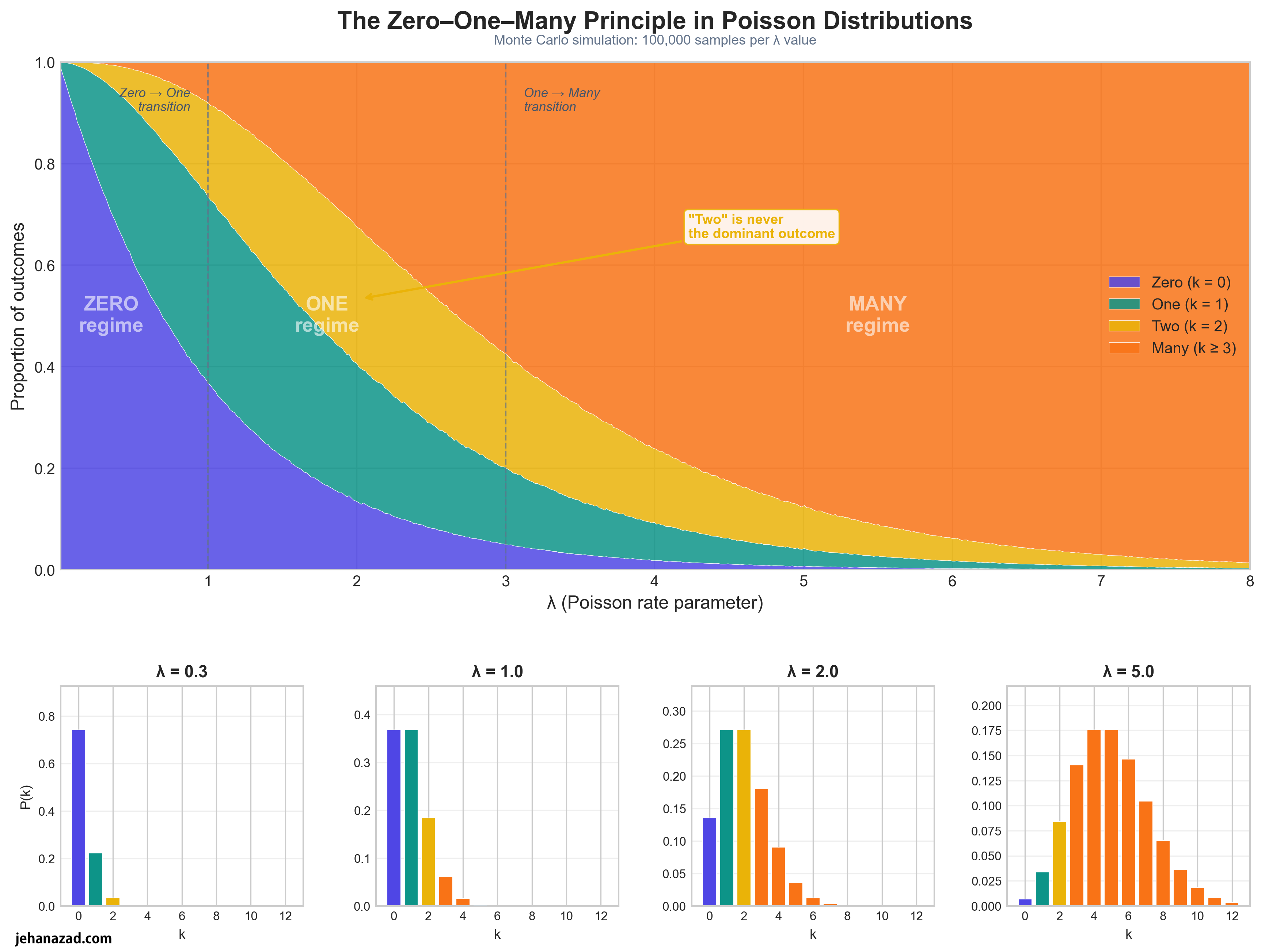
From this chart, you can see that there are regions where 0 instances dominate (i.e., a very low rate), and regions where 1 dominates the non-zero instances. There, however, is no rate for which 2 dominates. Even when the average rate is λ = 2 per hour, in hours where meteors are seen, you see exactly 2 only a third of the time.
The upshot is that in natural distributions, exactly two instances of something should not be common. If you’ve seen two of something, expect more to come.
Exceptions that Prove the Rule
The examples that seem to be exceptions end up being enlightening:
1. Number of Sexes: This seems like 1, 2, many, but sexual reproduction only makes sense in the context of multiple gametes. Either gamete never merges (asexual reproduction), merges once (sexual reproduction), or does the slime mold thing (many merges).
2. Official Languages in a Country: This can be zero (Mexico), one (China), or many (India). However, you also get countries like Canada and Belgium with two. This is a case of two regions with their own languages, tied together for historical and political reasons. It’s an unstable equilibrium, and both have had to deal with separatist issues.
3. Gods in a Religion: Zero (atheism, some Buddhism), one (monotheism), or many (polytheism). Zoroastrianism has two, but possibly because you need to pick one to worship, monotheism seems to be an attractor: one god ends up as the good one and the other as the bad one. This is what we now have among modern Parsis. Manichaeism is explicitly dualist, and maybe it’s not a coincidence that it no longer exists.
Two is not where things settle; it's the place they're passing through. If you find exactly two of something, either more are coming, or look closer — the two are really one.
I think the Poisson process is too specific to explain the general phenomena. I think of it like this:
A thing either exists or doesn’t: 0 vs. 1.
An existing thing either proliferates or doesn’t: 1 vs. many.
Two is a particular case of many. It’s competing with 3, 4, 5, etc. in the many ”bucket” so we don’t observe it as much as 0 or 1, which get their own buckets.
I like this post, and I hadn't heard of the Zero-One-Many concept, so thanks for sharing! Counterexamples abound, obviously, but I suppose that's part of the fun of a post like this. Albanian has two primary dialects, Gheg and Tosk, and lacks the same separatist impulse that the other dual-dialect systems you mention have. I suppose the core idea is that if something is repeatable once, then it can often be repeatable more than once.
(I would say that I'm not sure that using the Poisson distribution as an example is fully correct here. If you set lambda equal to 2.5, you get 2 as the modal outcome, don't you?)