

The Fermi Paradox is the idea that we should expect to see other intelligent life because the universe is so huge (10^25 planets). We don’t, and this is surprising.
UFOs are weird things that fly around, possibly aliens.
Though related, these are not the same. A paper that refutes the Fermi Paradox does not refute UFOs and sometimes actually supports the likelihood of UFOs.
(Other objections to UFOs covered in these posts.)
In fact, UFO sightings are themselves evidence against the Fermi Paradox. The paradox asks, “Why don’t we see aliens?”, and UFO sightings say, “You do, we’re right here!”
Here’s three commonly cited papers on the topic:
1. Dissolving the Fermi Paradox
This paper by Sandberg, Drexler, and Ord was reviewed on Slate Star Codex, and it delivers on its title: the Fermi Paradox largely dissolves. Using a Monte Carlo simulation to map out the alien-life scenarios that were discussed in other papers, they find that 30% of the time, you’d expect less than one civilization per galaxy.
This is a Poisson distribution, with intelligent life being very rare. Most galaxies have no intelligent life, but occasionally, due to improbably good conditions, you’d have one lone civilization. There would almost never be two in the same galaxy, so most observers wouldn’t see anyone else.1
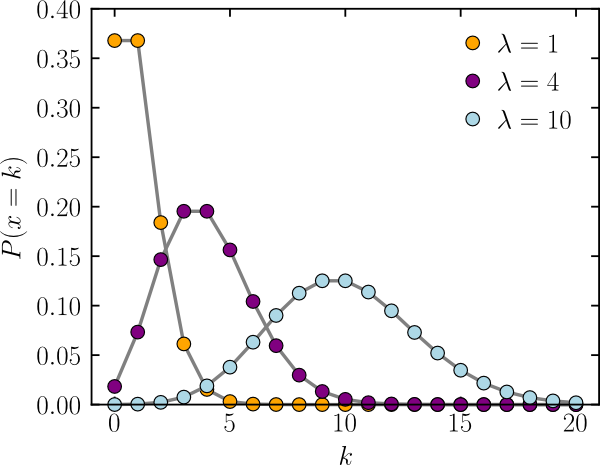

The math checks out, so aliens are unlikely?
No. That means the Fermi Paradox is unlikely. In 30% of scenarios, there is no intelligent life in the typical galaxy, so it’s entirely possible we’re alone. Still, this leaves 70% of scenarios where there should be life to find.
Don’t be surprised by no aliens; it’s 30% of scenarios.
Don’t be surprised by aliens; it’s 70% of scenarios.
2. Eternity in six hours
Another paper by Sandberg, along with Armstrong, calculates that just six hours of a star’s energy is enough to send self-replicating probes across the known universe. Earth is a relatively young planet, so if probes were sent by an earlier-emerging civilization, they’d have had plenty of time to reach us.
That means if we haven’t seen any probes, there’s probably no other intelligent life in the universe. Again, the math does check out.
The paper claims: If there are no probes, there are no aliens.
The paper does not claim: There are no aliens, so there are no probes.
There are no aliens, conditional on the absence of probes. Evidence for UFOs (i.e. alien probes) is an input to this paper, not an output.
3. Grabby Aliens
Robin Hanson’s grabby aliens paper doesn’t ask about the Fermi Paradox, but rather why intelligent life seems to have appeared on Earth so quickly. He says it’s because “grabby aliens” gobble up all the other planets before life can emerge on them. Earth had life early because that was the only time it was possible; later on, all the planets will have been consumed.
His support for the claim that life was quick to show up on Earth is that most stars are much longer-lived than the Sun:
If stars of all masses were equally habitable, most habitable years should lie in planets at the far-longer-lived small mass stars. After all, 95% of stars last longer than our sun, and some last roughly two thousand times longer.
But there’s a much simpler explanation: stars are not all equally habitable—small mass stars might not sustain life. It could be that small stars don’t support rocky planets with an atmosphere, or it could be that their low luminosity (<10% of the Sun’s) won’t allow complex life.
We orbit a star in the ~95th percentile for mass. If all stars are equally habitable, it is improbable that we aren’t on one of the far more numerous, low-mass, and long-lived stars. Our big Sun implies that larger stars are more likely to support life.
Grabby Aliens on the Fermi Paradox
The Grabby Aliens Hypothesis has to address the Fermi Paradox, because if the universe is being grabbed up, we should see it in our telescopes. Hanson answers that if it happens fast enough, i.e., close to the speed of light, we won’t see it coming:
If their expansion speed were within∼25% of lightspeed, a selection effect implies that we are less likely to see than to not see such volumes.
The paper’s position is not only that there are aliens, but they “now control 40-50% of the universe volume.”
Extraterrestrial contact is therefore soon expected, and indeed, the author believes they’re already here.
Of course, this means our own emergence was highly unlikely, but we ask these questions only when it worked out, so we have to take our existence as a given.